AI · AIC-71

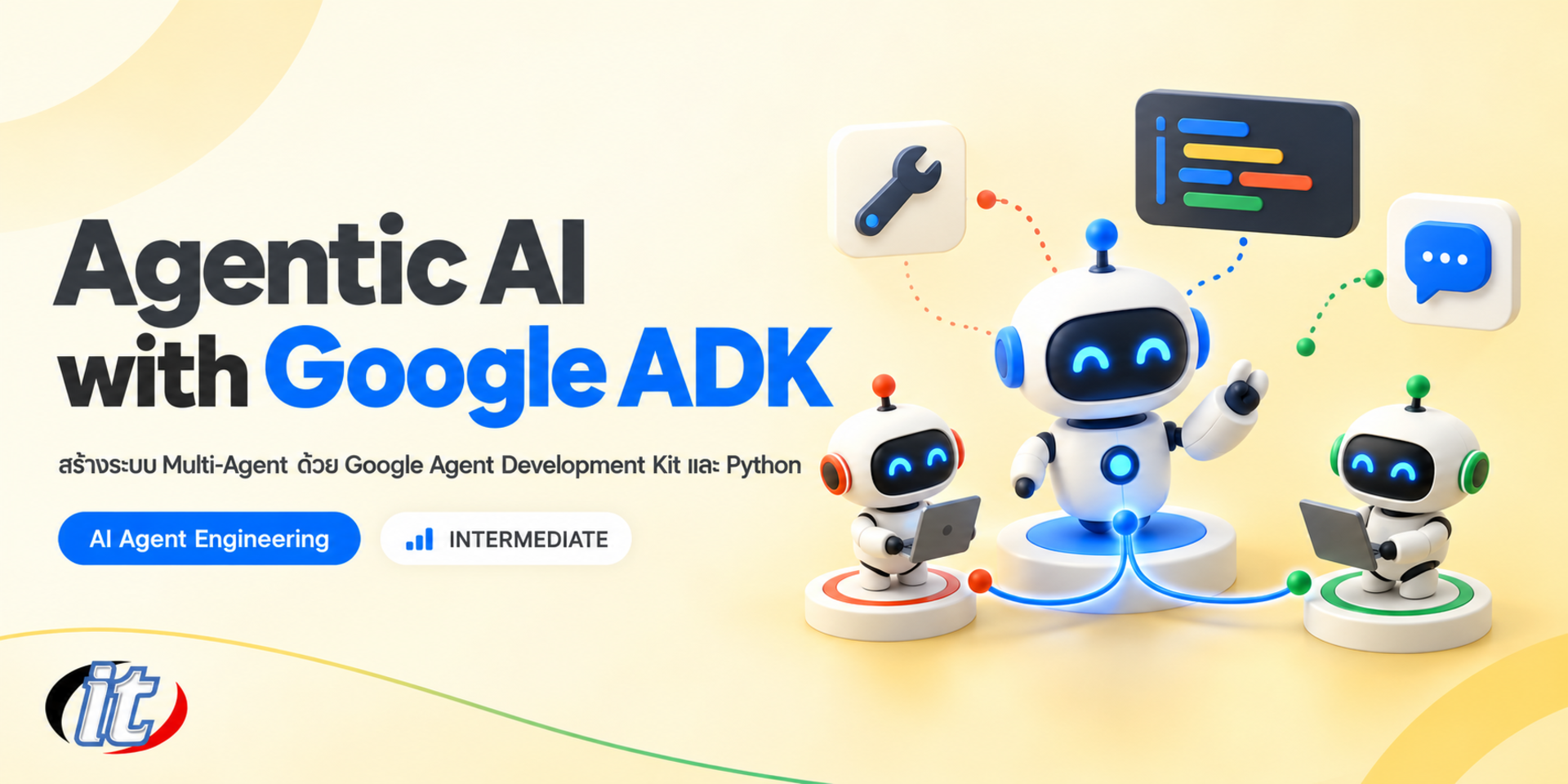
Agentic AI with Google ADK

Agentic AI with Google ADK is a hands-on course in building AI agents with Google's Agent Development Kit and Python, from designing agents and tools and managing sessions and memory to multi-agent systems, evaluation and deployment on Google Cloud. It suits Python developers and AI engineers building agents for real work, and you leave with a working multi-agent prototype of your own.

Updated
From 7,110 THB / person 7,900 −10% excl. VAT 7% · group rates available
PDFDownload the course outline
  • Duration12 hours · 2 days
  • FormatOnsite / live online
  • Next roundOn request
  • LevelIntermediate

Course overview

AI agents are moving beyond chatbots that only answer questions towards systems that plan, call tools and carry out multi-step work on people's behalf. Once teams start building them, though, the same questions keep coming up: how to split work across several agents, where to keep conversation context, how to stop an agent from doing things it should not, and how to know an agent behaves correctly before it goes live. Google's Agent Development Kit (ADK) is an open source framework designed to answer these questions in a structured way.

This course takes learners through building AI agents with Google ADK and Python, from a first agent running on a Gemini model to a production-ready multi-agent system. It starts with designing an LlmAgent and writing tools, including function tools, built-in tools, OpenAPI tools and MCP tools, then covers sessions, state and memory and controlling behaviour with callbacks. From there it moves on to dividing work between agents with sub-agents, AgentTool, workflow agents and the graph workflows introduced in ADK 2.0. It closes with evaluation, deployment to Google Cloud and a capstone in which learners build a multi-agent system of their own. (2 days, 6 hours per day, 12 hours in total, Intermediate level.)

What you’ll gain

  • Install Google ADK, build agents on Gemini models and test them with the Dev UI and CLI
  • Design agent instructions, output schemas and tools that work precisely
  • Connect agents to external systems through function tools, OpenAPI and MCP
  • Manage sessions, state and memory so agents keep the right context
  • Use callbacks and plugins for guardrails and for logging agent activity
  • Design multi-agent systems with sub-agents, AgentTool, workflow agents and graph workflows
  • Measure agent quality with evaluation and deploy agents to Google Cloud

Who this course is for

  • Python developers who want to build AI agents for real work in their organisation
  • AI engineers and backend developers looking for a framework for multi-agent systems
  • Teams already using Google Cloud or Gemini who want to move into agentic AI
  • Solution architects who design agent architectures and their deployment
  • Anyone who has built an LLM chatbot and wants to turn it into an agent that handles multi-step tasks

Prerequisites

  • Working knowledge of Python, such as functions, classes, virtual environments and installing packages
  • A basic understanding of using LLMs and writing prompts
  • Basic command-line, Git and REST API skills
  • A laptop that can run a Python version supported by ADK and VS Code, plus a Google account for Google AI Studio

Curriculum

Course Details

This course runs for 2 days, 6 hours per day (12 hours in total, 09:00-16:00), as lectures with labs that grow a single scenario throughout, from a first agent to a multi-agent help desk system. Intermediate level. It uses Google ADK for Python with Gemini models through Google AI Studio or Vertex AI. Most labs run on the learner's own machine, and the deployment lab uses the learner's own Google Cloud project. The course focuses on Google ADK itself, covering tools, sessions, callbacks, multi-agent design, ADK 2.0 graph workflows, evaluation and deployment. Learners take home a lab guide, Python sample code for every lab and a capstone starter project.

Day 1 Building Agents and Connecting Tools

Section 1: Lab: Getting Started with Google ADK and Your First Agent

  • What agentic AI is, and how ADK differs from calling an LLM API directly

  • An overview of ADK 2.0 and its core building blocks: agents, tools, the Runner and sessions

  • Install ADK for Python, scaffold a project with adk create and configure Gemini through Google AI Studio or Vertex AI

  • Lab: run a first agent with adk run and test it in the Dev UI with adk web

Section 2: Designing an LlmAgent That Works Precisely

  • name, description and instruction that help an agent decide correctly, including values from state

  • Choose a Gemini model, tune generate_content_config and use other models through LiteLLM

  • Enforce output structure with output_schema and save results to state with output_key

  • Lab: a product Q&A agent that returns structured data

Section 3: Lab: Function Tools Your Agent Can Call

  • Turn Python functions into tools with clear type hints and docstrings

  • Design return values, and use ToolContext to read and write state

  • Long running function tools for work that waits on a result or an approval

  • Lab: an agent that checks orders and calculates shipping from sample data

Section 4: Built-in Tools, OpenAPI and MCP Tools

  • Built-in tools such as Google Search and code execution, and their limitations

  • Generate tools from an OpenAPI spec and connect MCP servers through McpToolset

  • Handle tool authentication and credentials securely

  • Lab: an agent that looks up data through an MCP server and calls an internal API

Section 5: Sessions, State, Memory and Artifacts

  • How sessions and events hold context, and the different SessionService options

  • Scoping state with the user:, app: and temp: prefixes

  • MemoryService for recalling past conversations, and artifacts for files

  • Lab: an assistant agent that remembers user preferences across sessions

Section 6: Lab: Callbacks, Plugins and Guardrails

  • Callbacks before and after agent, model and tool execution

  • Filter requests, mask personal data and validate arguments before calling tools with side effects

  • Plugins for app-wide policies such as logging and rate limiting

  • Lab: add guardrails and an audit log to the agent from the previous section
Day 2 Multi-Agent Systems, Evaluation and Deployment

Section 7: Designing Multi-Agent Systems

  • When to split work across agents, and the coordinator and specialist patterns

  • sub_agents and transfer compared with calling an agent as a tool through AgentTool

  • An overview of the A2A protocol: exposing an agent to other systems and calling remote agents

  • Lab: a help desk system with a triage agent and specialist agents

Section 8: Lab: Sequential, Parallel and Loop Workflow Agents

  • SequentialAgent for work that runs step by step as a pipeline

  • ParallelAgent for independent work run side by side, and LoopAgent for draft and review cycles

  • Passing results between steps with output_key and state

  • Lab: an automated pipeline that researches, drafts and reviews a report

Section 9: Graph Workflows and Human-in-the-Loop in ADK 2.0

  • The graph workflow model, where agents, tools and functions become nodes

  • Conditional routing between nodes, and dynamic workflows controlled by code

  • Pausing for human approval (human-in-the-loop) before critical steps

  • Lab: a request approval workflow that asks the user to confirm before acting

Section 10: Lab: Evaluation and Observability

  • Build eval sets from Dev UI conversations and run them with adk eval

  • Measure both the tool call trajectory and the quality of responses

  • Read traces of events and tool calls to find out why an agent answered wrongly

  • Lab: write a test suite for the help desk system and fix it until it passes

Section 11: Serving Through an API and Deploying to Google Cloud

  • Use the Runner, read streaming events and expose an API with adk api_server

  • Compare Agent Runtime, Cloud Run and GKE, then deploy with adk deploy

  • Manage secrets, persistent sessions, access control and logs in production

  • Lab: deploy the help desk system to Cloud Run and call it from a web page

Section 12: Workshop: Multi-Agent Capstone

  • Pick a real-world brief such as a sales assistant, an HR assistant or an internal help desk

  • Design the agents' roles, tools, state and guardrails

  • Build the system with ADK, including at least one eval set

  • Present the work, review it together and wrap up with a pre-production checklist

Schedule & training options

For individuals — public rounds

No public rounds are open right now. Join the waiting list and we will contact you first when the next round opens, or ask us on LINE. Or call 02-570-8449 or 088-807-9770

For organisations — in-house / private

  • Tailor the content to your team’s tools and projects
  • Your dates, at your office or live online
  • Quotation with tax ID for procurement
Corporate training quote

Instructors

Frequently asked questions

Who is Agentic AI with Google ADK for, and what background is needed?

Built for Python developers who want to build AI agents for real work in their organisation · AI engineers and backend developers looking for a framework for multi-agent systems · Teams already using Google Cloud or Gemini who want to move into agentic AI Background you should have: Working knowledge of Python, such as functions, classes, virtual environments and installing packages · A basic understanding of using LLMs and writing prompts Not sure the fit is right? Talk to our team on LINE @itgenius or call 02-570-8449.

How much does Agentic AI with Google ADK cost and how long does it run?

THB 7,900 (currently THB 7,110 on promotion). The course runs 12 hours. The price excludes 7% VAT (for payment in a company's name). Pay by bank transfer to the company account, confirm it on our payment page, and we can issue the receipt or tax invoice in your company's name.

Do I get a certificate?

Yes. Everyone who completes the course receives a Certificate of Completion from IT Genius Institute. Each certificate carries its own number, and anyone holding that number can verify it online on our certificate page, so you can add it to your portfolio or pass it to HR as evidence of training.

Where does the training take place, and is there an online option?

You can attend onsite at IT Genius Institute or arrange to join online, and we also run it as a private in-house session for your team. Ask about dates and venues on LINE @itgenius or call 02-570-8449.

What if I fall behind or miss a session — can I retake it?

Yes. You may retake the same course free of charge in a later round, under the institute's conditions. Tell our team which course and round you attended, and we will check it and offer you the rounds that still have seats. Ask us on LINE @itgenius or call 02-570-8449.

How do I enrol, or request a quotation for my company?

Enrol online with the registration form on this page. You can register several attendees at once and enter your tax ID and billing address for the tax invoice. Or request a company quotation straight from the quote button. For anything else call 02-570-8449 or reach us on LINE @itgenius.