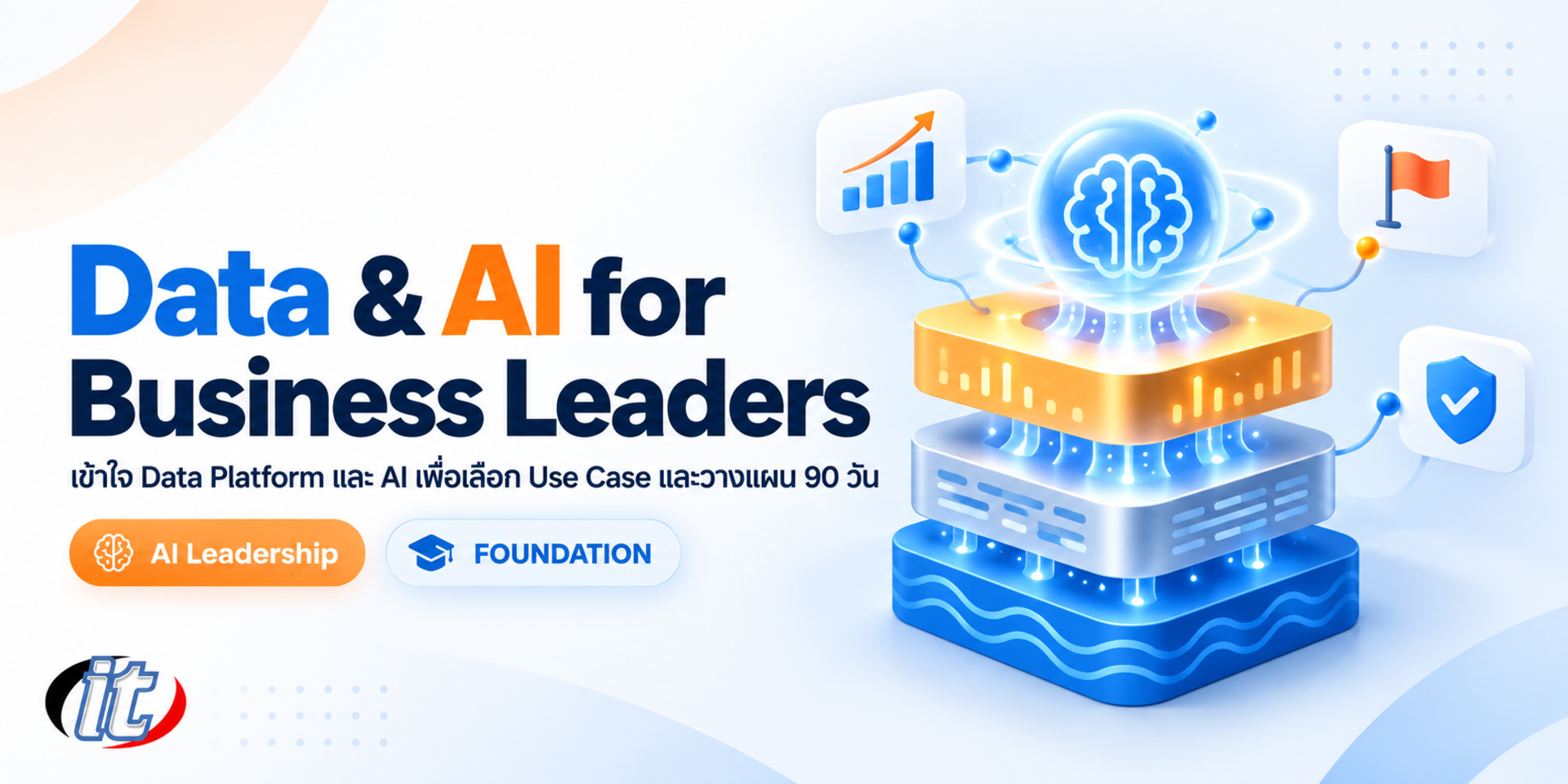
Data & AI for Business Leaders is an executive course that explains data platforms, Lakehouse architecture and Microsoft Fabric in business terms and separates predictive, generative and agentic AI. It suits C-level executives and business-unit heads who decide on data and AI investment, and you leave with a draft 90-day action plan with owners and KPIs.
Many organizations have already invested in data and AI, yet their leaders still struggle to say where to start, which projects are worth funding and how to keep the risks under control. Conversations with technical teams are full of jargon, while decisions about platforms, budgets and priorities belong to business leaders. Leaders therefore need enough of the big picture to ask the right questions and tie data and AI investment to business goals.
This course explains the components of a modern data platform in business language, from the Lakehouse and the Medallion architecture to where Microsoft Fabric and cloud platforms fit. It separates Predictive, Generative and Agentic AI, and provides frameworks for selecting use cases and assessing ROI, setting platform strategy, governing risk and applying Responsible AI, and managing change and the operating model. Participants work on business problems from their own units in group activities and finish the day with a draft 90-day action plan they can start on straight away. (1 day, 6 hours, Executive level.)
What you’ll gain
Explain the components of a modern data platform, including the Lakehouse and the Medallion architecture, in business language
Understand where Microsoft Fabric and cloud platforms fit in the overall data platform picture
Distinguish Predictive, Generative and Agentic AI and know which kind of work each one suits
Identify high-ROI data and AI use cases for your own business unit
Ask the right questions about data quality, governance and risk in AI projects
Draft a 90-day action plan for your team, with owners and success measures
Who this course is for
C-suite executives such as the CEO, CFO, COO, CIO, CDO and CTO
Business unit heads and senior managers who decide on data and AI investment
Board members, and strategy or digital transformation leaders
Risk, compliance and legal leaders who oversee the use of data and AI
This course is not hands-on technical training, so it does not suit data engineers, data scientists or developers looking for practical labs
Prerequisites
No technical, data or programming background is required
Experience in business decision-making or managing a team will help you get more out of the day
Openness to discussion and change, and willingness to take part in group activities
Bring 2-3 business problems that data or AI might help with, and a rough view of your current data systems
Curriculum
Course Details
A 1-day, 6-hour course (09:00-16:00) at Executive level for senior leaders and business decision-makers, delivered through presentation, discussion and group activities based on participants' own business problems. There is no coding or system setup and no technical background is needed. Participants should bring 2-3 business problems that data or AI might help with and a rough view of the data systems their unit uses today. They take home a summary of data platform concepts and AI types, a use case prioritization form, a list of questions on data quality, governance and risk, and a draft 90-day action plan for their team.
Day 1: From Understanding Data and AI to a 90-Day Action Plan
Section 1Why Data and AI, and Why Now
How data and AI change competition, decision-making and work once Generative AI reaches people at every level
Why many data and AI projects fall short of expectations
The leader's role: set direction, prioritize and allocate resources
Section 2Data Platform Foundations in Business Language
How data flows from operational systems to reports, and how a data warehouse, a data lake and a Lakehouse differ
The Medallion architecture: Bronze, Silver and Gold layers and how ready the data is at each
Where Microsoft Fabric and cloud platforms fit, and what to ask your team about the systems you run today
Section 3Predictive, Generative and Agentic AI
Predictive AI forecasts and detects anomalies, while Generative AI creates content, summarizes and answers questions
Agentic AI: AI that plans and carries out multi-step work under control
Matching the type of AI to the problem, and the limitations leaders need to know
Section 4Use Case Selection and ROI
Start from the business problem, then assess value, data readiness, feasibility and risk
Estimating cost, return and success measures for a use case
Workshop: prioritize use cases from the business problems participants bring
Section 5Platform Strategy
A unified platform such as Microsoft Fabric compared with assembling several cloud services
Decision factors: fit with existing systems, cost, team skills, security and scalability
Build or buy, and starting with a pilot before scaling up
Section 6Governance, Responsible AI and the Operating Model
Data governance: data ownership, data quality and access rights
AI risk and Responsible AI principles: accuracy, bias, privacy and human review
Driving change: building adoption, and the roles of leaders, data teams and business users
Centralized, federated or hybrid operating models, and building data and AI skills
Section 7Workshop: The 90-Day Action Plan
Choose the use case to start with, set goals and measures, and assess readiness in data, people and governance
Define what must happen at 30, 60 and 90 days, with named owners
Workshop: draft your unit's 90-day plan and present it for feedback from the group
Schedule & training options
For individuals — public rounds
No public rounds are open right now. Join the waiting list and we will contact you first when the next round opens, or ask us on LINE. Or call 02-570-8449 or 088-807-9770
What is the difference between a data warehouse, a data lake and a lakehouse?
A data warehouse stores structured, cleaned data and suits reporting and BI that need precise figures. A data lake stores raw data of any kind at low cost, from tables to files and text, but becomes hard to use without good management. A lakehouse combines the two, keeping all kinds of data in one place while adding the table management, access control and quality checks of a warehouse, so the same data serves both reporting and AI.
What are the Bronze, Silver and Gold layers of the Medallion architecture?
The Medallion architecture organises data into three layers by readiness. Bronze holds raw data as it arrives from source systems, Silver holds data that has been cleaned, de-duplicated and joined, and Gold holds data summarised from a business perspective, ready for reports, dashboards or AI models. Executives can use it to ask their team which layer a decision figure comes from and whether it has passed quality checks.
How do predictive AI, generative AI and agentic AI differ?
Predictive AI learns from historical data to forecast or classify, such as projecting sales, predicting customer churn or detecting unusual transactions. Generative AI creates new content, such as summarising documents, drafting emails or answering questions from a knowledge base. Agentic AI plans and carries out multi-step work itself, such as looking up data, calling systems and passing work on, within defined limits and controls. The choice should start from the business problem, not the technology.
Who is the Data & AI for Business Leaders course for, and what should I know beforehand?
It suits C-level executives such as the CEO, CFO and CIO, business unit heads who decide on data and AI investment, board members and digital transformation leaders, and risk and compliance leaders. No technical or programming background is required, although experience of business decisions or managing a team will help. It is not hands-on technical training, so it does not suit data engineers or developers looking for labs.
What will I be able to do after the Data & AI for Business Leaders course?
You will be able to explain data platforms, the lakehouse and the role of Microsoft Fabric in business terms, match the right type of AI to a problem, identify and rank use cases by value, data readiness and risk, ask the right questions about data quality and governance, and draft a 90-day action plan for your team with owners and success measures. Participants who complete the training receive a Certificate of Completion with its own number, which can be verified online.
Can the Data & AI for Business Leaders course be run in-house for our team?
Yes. It can be run in-house for your leadership team, with examples adapted to your own work, such as using your organisation's business problems and data systems in the use-case prioritisation workshop. You can request a quotation from this page, or contact us on LINE @itgenius or by phone on 02-570-8449.
AI is becoming a basic organizational capability, just like the internet, cloud and digital transformation before it. Executives do not need to know how to build an AI model or write code, but they should understand what AI is, what it can and cannot do, how…
AI is only as smart as the data it is fed. Many AI projects fail not because of the technology but because data is scattered across many places, product or vendor codes do not match between systems, records are incomplete, or no one clearly owns the data. At…
Many organizations start AI projects with real enthusiasm, yet a good number get stuck in pilots that never finish, known as pilot purgatory, because the problem was never clearly defined, the data was not there to support it, nobody owned the project,…