AI · AIC-28

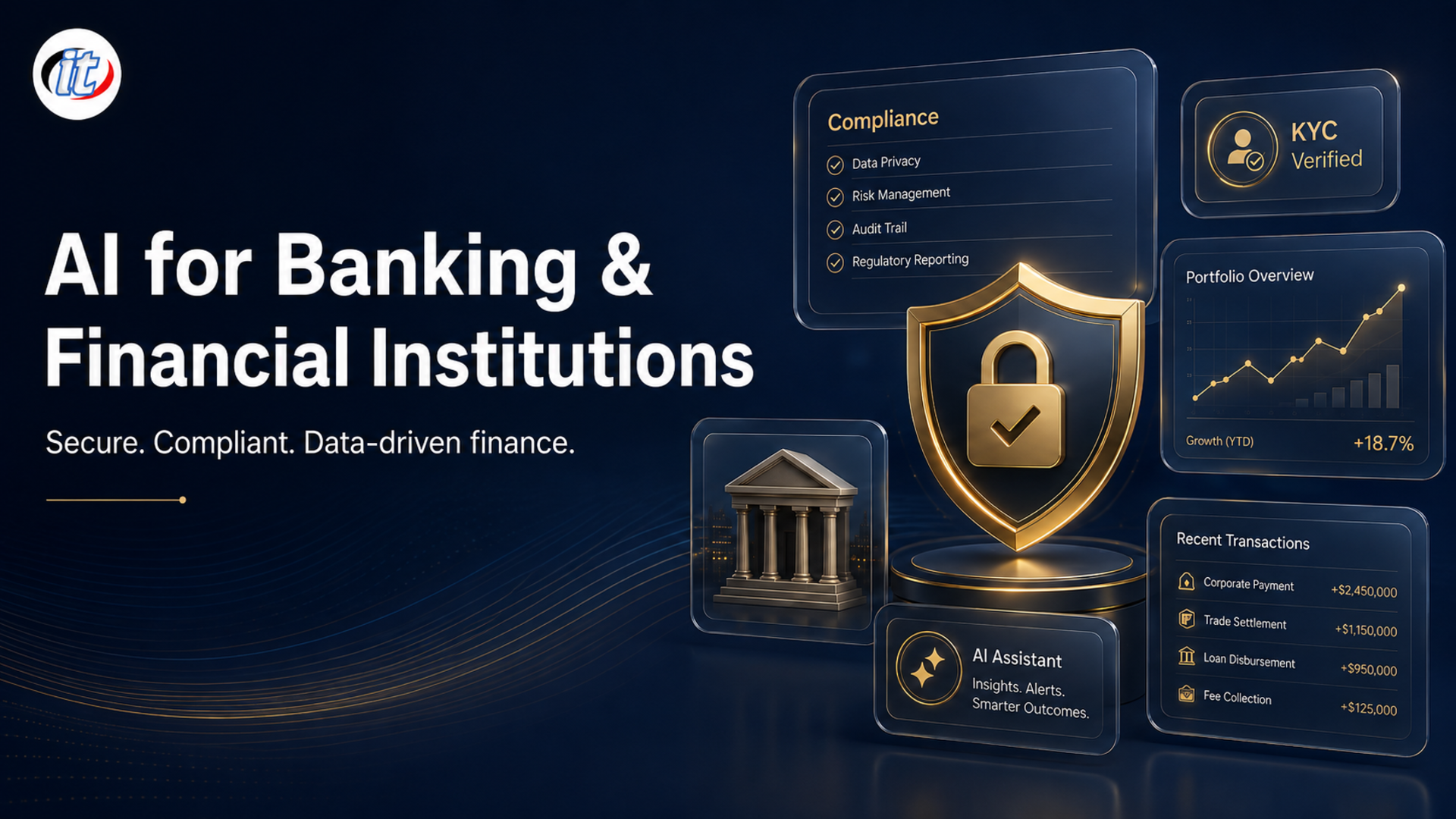
AI for Banking & Financial Institutions

AI for Banking & Financial Institutions is a course in using AI safely and within regulation at banks and financial institutions, covering documents and reports, transaction and portfolio analysis, customer service, and risk and compliance support. It suits staff at banks, securities firms and insurers, and risk, compliance and internal audit teams.

Updated
From 8,010 THB / person 8,900 −10% excl. VAT 7% · group rates available
PDFDownload the course outline
  • Duration12 hours · 2 days
  • FormatOnsite / live online
  • Next roundOn request
  • CertificateIncluded

Course overview

Banks and financial institutions are an industry with large volumes of data and documents, under strict regulation, and demanding very high data accuracy and security. Routine tasks such as preparing documents and reports, communicating with customers, analyzing transaction and portfolio data, summarizing policies and regulations, and risk and compliance work are time-consuming and costly. Generative AI greatly reduces the time spent on these tasks, but because the data is sensitive and the industry is regulated, the key is using AI the right way, with verification mechanisms and strong data governance. This course is designed to help banking and financial institution teams use AI

in real work confidently, safely and in a compliant way, covering documents and reports, financial data analysis, customer service and products, risk and compliance work, setting up internal assistants and a knowledge base, and automation with n8n, with data governance, security and PDPA for customer data as the core of every topic. All content is taught through workshops on real financial institution tasks using simulated data, finishing with a capstone project where learners set up an end-to-end AI toolkit for their own work. (2 days, 6 hours per day, 12 hours in total, Beginner to Intermediate level, no AI or programming background required.)

What you’ll gain

  • Understand how AI changes financial institution work and choose the right AI tool for regulated tasks
  • Design prompts for banking and finance work and keep results accurate, referenced and traceable
  • Use AI to prepare documents, reports and customer communication that are accurate and formal
  • Use AI to analyze financial, transaction and portfolio data with number-verification mechanisms
  • Use AI to help with customer service and financial product work
  • Use AI to help with risk and compliance work, such as summarizing regulations and checking policies
  • Understand how AI supports KYC/AML and basic risk analysis (in an assistive role)
  • Set up internal assistants and a knowledge base with Custom GPT/Gems and automation with n8n
  • Set data governance, data security and PDPA for financial institutions
  • Understand AI limits and risks in a regulated industry and set responsible practices

Who this course is for

  • Staff and managers in banks, securities firms, insurers and financial institutions
  • Operations, product, customer service and relationship manager teams
  • Risk, compliance and internal audit teams
  • Data and analyst teams in financial institutions who want to use AI safely
  • Financial institution executives who want to set up AI systems and practices organization-wide

Prerequisites

  • General computer and internet skills
  • Basic Microsoft Excel or Google Sheets skills
  • Understanding of your financial institution work or process to use as a case study during training
  • No AI or programming background required

Curriculum

Course Details

A 2-day course, 6 hours per day (12 hours in total), delivered as a hands-on workshop on simulated data with a capstone project. Beginner to Intermediate level, no AI background required. The course focuses on using AI as an assistive tool within a data governance framework, with decisions in regulated work remaining with the organization's people and processes. Learners take home a prompt library, an internal assistant (Custom GPT/Gem), document and product FAQ templates, and a data governance framework with a PDPA checklist.

Day 1 AI for Documents, Data and Customer Service

Section 1: AI in Banking and Financial Institutions

  • An overview of generative AI in financial institution work and what changes in the process
  • AI use cases: documents, reports, analysis, customer service, risk and compliance
  • Industry-specific risks and a framework for responsible AI use
  • Choosing the right AI tool for regulated tasks

Section 2: Prompts and Output Control for Finance Work

  • A good prompt structure for finance: role, context, data and output format
  • Instructing AI to reference sources and show reasoning so results are traceable
  • Preventing hallucination and setting verification mechanisms for numbers and regulations
  • Building a team prompt library for recurring work

Section 3: Documents, Reports and Customer Communication

  • Using AI to draft documents, reports and formal letters
  • Preparing product documents and explaining terms so customers understand, accurately
  • Cautions on accuracy, disclosure and review before real use
  • Workshop: draft one document or customer communication with AI plus a review mechanism

Section 4: Financial Data Analysis and Reporting

  • Using AI to analyze transaction, portfolio and KPI data (on simulated data)
  • Finding anomalies and trends worth checking
  • Preparing executive reports that support decisions, with number verification
  • Workshop: use AI to analyze a simulated financial dataset and summarize key points

Section 5: Customer Service and Financial Product Work

  • Using AI to help answer customer questions and explain financial products accurately
  • Preparing standard answer sets and FAQ for the service team
  • Tailoring communication to each customer group without giving advice beyond scope
  • Workshop: prepare a product FAQ or customer service message set with AI
Day 2 Risk, Compliance, Internal Assistants and Governance

Section 6: Risk, Regulation and Compliance with AI

  • Using AI to summarize and compare regulations, rules and internal policies
  • Helping check document alignment with policy (policy check) in an assistive role
  • Preparing compliance documents and reports systematically
  • Workshop: use AI to summarize one set of regulations and build a compliance checklist

Section 7: Risk Analysis and KYC/AML Support

  • How AI supports KYC and customer data summarization (in an assistive role)
  • Helping spot suspicious patterns and initial risk issues, with a person always deciding
  • Scope and limits: AI is an assistive tool, not a decision-maker in regulated work

Section 8: Internal Assistants and Knowledge Base

  • Building a Custom GPT or Gem as an internal assistant answering policy and product questions
  • Embedding policies and knowledge for consistent, controllable results
  • Approaches to limiting permissions and controlling the data the assistant can access
  • Workshop: build one internal assistant to answer common policy questions

Section 9: Financial Institution Automation with n8n

  • Setting up automation with n8n, such as report summaries and due-date alerts
  • Connecting data across internal systems safely and controllably
  • Security and access-permission cautions in automation
  • Workshop: design one simple automation flow for internal work

Section 10: Data Governance, Security and PDPA

  • Data that must not go into AI: customer data, transaction data and confidential data
  • Handling data before use with AI and choosing AI services suitable for sensitive data
  • Personal data under PDPA and a data governance framework for financial institutions
  • Setting the organization's responsible AI usage policy

Section 11: Capstone Project and Real-world Adoption

  • Task: set up an end-to-end AI toolkit for the learner's work within a governance framework, from documents and analysis to internal assistants and compliance work
  • Present the work and get feedback from the instructor and peers
  • A first-30-days adoption plan and setting up safe AI use organization-wide

Schedule & training options

For individuals — public rounds

No public rounds are open right now. Join the waiting list and we will contact you first when the next round opens, or ask us on LINE. Or call 02-570-8449 or 088-807-9770

For organisations — in-house / private

  • Tailor the content to your team’s tools and projects
  • Your dates, at your office or live online
  • Quotation with tax ID for procurement
Corporate training quote

Instructors

Frequently asked questions

How far can AI help with KYC and AML work?

AI works best as an assistant: summarising customer documents, checking them against a checklist, summarising relevant news or public sources and drafting notes for reviewing suspicious transactions, which saves a great deal of paperwork time. Decisions on onboarding customers, assigning risk ratings and reporting transactions must stay with staff and the organisation's own processes, and only tools approved for data security should be used.

How do you stop AI giving wrong or invented information in banking work?

Have the AI answer from documents your organisation has approved, such as regulatory notices, internal rules or product manuals, rather than the model's general knowledge. Ask it to cite the section or page it used and to say when it does not know. Calculate figures through formulas or systems that can be audited, and require human review of anything going to customers or regulators so every step is traceable.

How do you use AI to summarise regulations and check policies for compliance?

Attach the actual regulation or notice and ask the AI to summarise it into the requirements you must meet, citing the clause each comes from. Then attach your internal policy or manual and have the AI compare them point by point, showing which requirements are covered and which are missing or inconsistent, laid out as a gap analysis table. The compliance team should then review the results and interpret anything that needs judgement.

Who is the AI for Banking & Financial Institutions course for, and what should I know beforehand?

It suits staff and managers at banks, securities firms, insurers and other financial institutions, operations, product and relationship manager teams, risk, compliance and internal audit teams, and data teams who need to use AI safely. You need general computer skills, basic Excel or Google Sheets use and an understanding of your unit's processes. No AI or programming knowledge is required.

What will I be able to do after the AI for Banking & Financial Institutions course?

You will be able to write prompts that give citable, traceable output, use AI to draft documents, reports and customer communications, analyse transaction and portfolio data with number checks, summarise regulations and review policies, use AI as an assistant for KYC and AML work, set up internal assistants with Custom GPTs or Gems, and apply data governance in line with PDPA. Participants who complete the training receive a Certificate of Completion with its own number, which can be verified online.

Can the AI for Banking & Financial Institutions course be run in-house for our team?

Yes. It can be run in-house for your team, with examples adapted to your own work, such as your unit's document types and processes practised on simulated data, and practices aligned with your organisation's data policies. You can request a quotation from this page, or contact us on LINE @itgenius or by phone on 02-570-8449.